
Employment and Independence Program

The Hotel Etico Employment and Independence Program is a pathway for young adults with disability and additional support needs. It is a pathway to greater independence, paid work, skills development and employment opportunities for young adults aged 18 to 35. The program operates at two locations, one in Leura, NSW and the other in Canberra, ACT.
Application Process
We review applications to assess how we can best support successful applicants and understand their employment and independence goals.
The full application process includes an interview, tour of your preferred location, trial sleepover and work taster. If offered a position, applicants complete onboarding paperwork and are given a date to join us on site.
Eligibility Criteria
This program is for young adults:
- aged 18 to 35.
- living with a disability and additional support needs.
- who want to become independent and are excited to take on the challenge.
Many of the young people currently or previously in our training program have intellectual disability or are neurodiverse. We have supported trainees with a range of disabilities including autism, ADHD, anxiety and Down Syndrome.
Year One
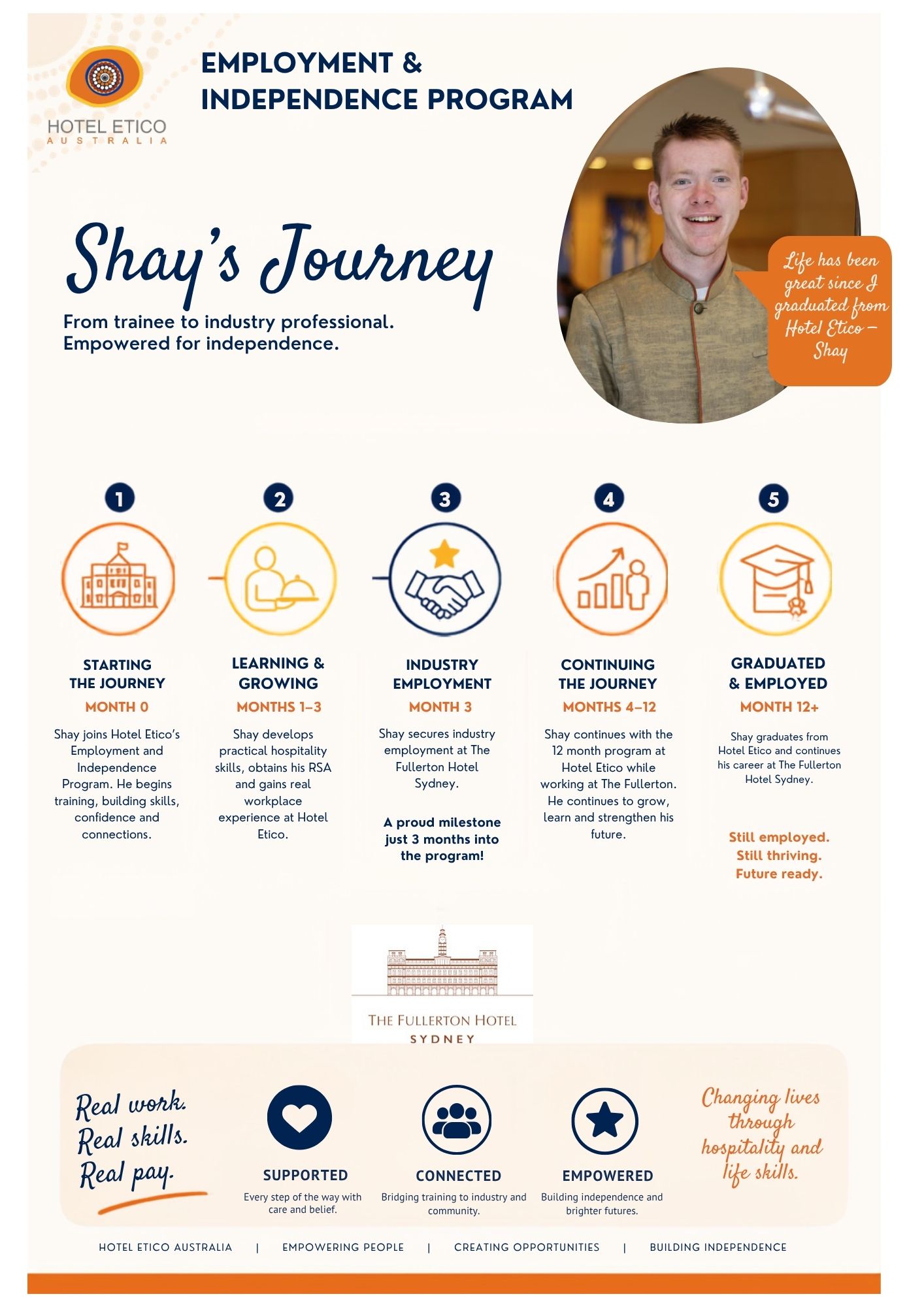 During the first year, trainees stay and train at a choice of two locations within working hotels. One is located in Leura in the Blue Mountains, NSW, and the other in Canberra, ACT.
The program has a rolling intake, allowing families to begin the application process throughout the year rather than waiting for an annual start date.
The trainees attend the program on a rotating weekly roster. During the first 3 months they train and participate in work experience every week. Individual work experience shifts are never longer than 8 hours and often split in two shifts of 4 hours, as hospitality is often quite physically demanding, requiring long periods of standing and working in a real, operating hotel. The program includes learning, work experience as well as structured training sessions covering hospitality and work skills.
Our trainees participate in the day-to-day operation of various departments of a hotel. These departments include: food and beverage (restaurant duties), housekeeping, back of house, (kitchen duties and reception (concierge duties).
Examples of Duties completed in the program:
Food and Beverage
- Taking Guests’ food orders
- Waitering
- Serving drinks behind the bar
- Cleaning and clearing the restaurant
Housekeeping
- Replacing Linens/ Room Cleaning
- Replacing amenities
- Guest bathroom cleaning
Reception/Concierge
- Check In and Check Out
- Answering guest questions
- Taking reservations
- Answering incoming calls.
Back of House (kitchen duties)
- Supervised Cooking
- Dishwashing
- Plating food
- Cleaning the Kitchen
Each of our trainees receives a unique experience based on their support needs and training location. The duties listed above are examples rather than a complete list of the work experiences gained at our academies.
Choosing a Focus
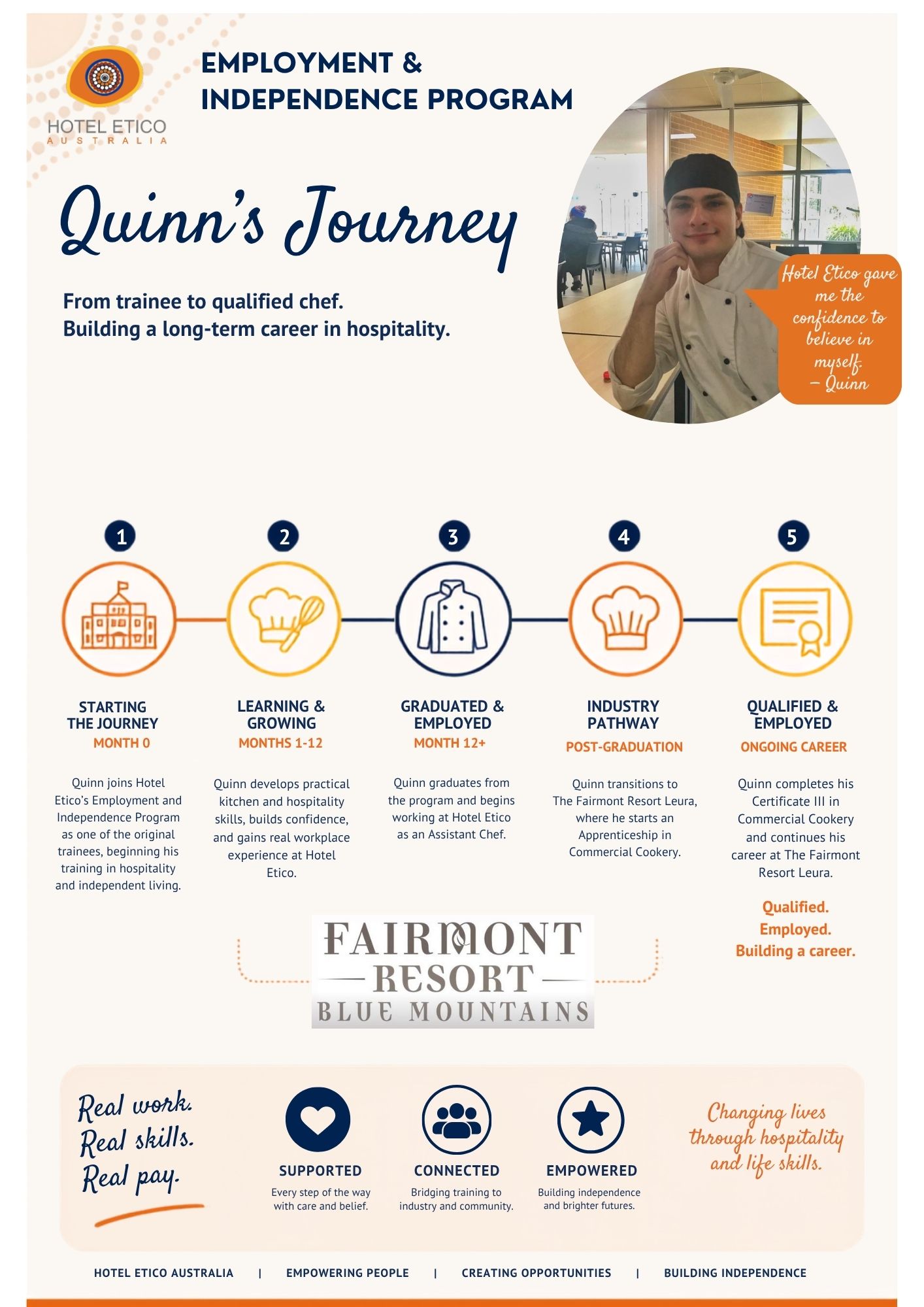 For the first three months of the program, trainees have the opportunity to have work experience in all departments of a hotel. During the first three months, trainees consult with our staff to select a focus based on their strengths and preferences and they are assessed for best job matching, using a competency framework developed by Hotel Etico in partnership with our partner hotels. A key aspect of this process is determining which roles we are best able to support trainees to perform. Most of the roles involve repetitive tasks, lifting heavy objects, carrying trays and fine motor control.
If the trainee is assessed as being able to be matched to roles within our hotel partners in Leura or Canberra, they may be offered a paid role by our partner hotels for the remainder of the residential program.
Workshops
Workshops are regularly held at each site to help trainees navigate aspects of work outside of completing their duties. These can include topics such as: professionalism and presentation, financial wellbeuing, reading a pay slip, understanding an employment contract and how to determine if they are being paid correctly. This training allows our trainees to transition successfully to open employment. The topics presented are dependent on each group of trainees, their interests and their independence goals.
Independent Living
Our independent living program focuses on functional daily living skills including meal preparation, self-management, communication and the responsibilities of shared living. Trainees are responsible for preparing to leave campus and cleaning their room at the end of each shift rotation. At each site, support workers encourage and assist trainees to organise common chores including cooking, cleaning and laundry. None of these tasks are performed for trainees, but support is always present to facilitate them being performed.
All training and support is delivered using a person-centered and strengths-based approach focusing on individual goals provided by the trainee and their parents or carers during the application process. Our training is autism and ADHD friendly, with each trainee also receiving one-on-one time for two hours a week with a support worker to work on their individual independence goals.
Shared living within the dedicated onsite accommodation creates the opportunity for social connections and relationship building. The trainees often spend their free time on site together, sharing meals, shopping and they organise movie nights and dinners. Support workers are present to encourage the trainees to participate and help them plan meals and activities as a group. Social activities and down time are important for our trainees, as their work will be physically demanding.
Accommodation
At the heart of our program is supported independent living, trainees stay on campus in an ensuite room during their rostered days. Where possible, trainees have their own room with private bathroom facilities and shared spaces including a kitchen, dining room and lounge. However, trainees may also share a bedroom and bathroom with another young person. Our trainees commute to and from campus either by car or public transport.
Completing Year 1
The first stage of the program does not always last for one year as trainees often find employment with one of our inclusive employment partners and are ready to start work early. Trainees have regular contact with our employer partners, often receiving offers of work, and may also apply for jobs during the first year. Other trainees continue learning and developing their skills for more than a year subject to additional funding and the availability of places, either through the NDIS or self funded.
Year Two:
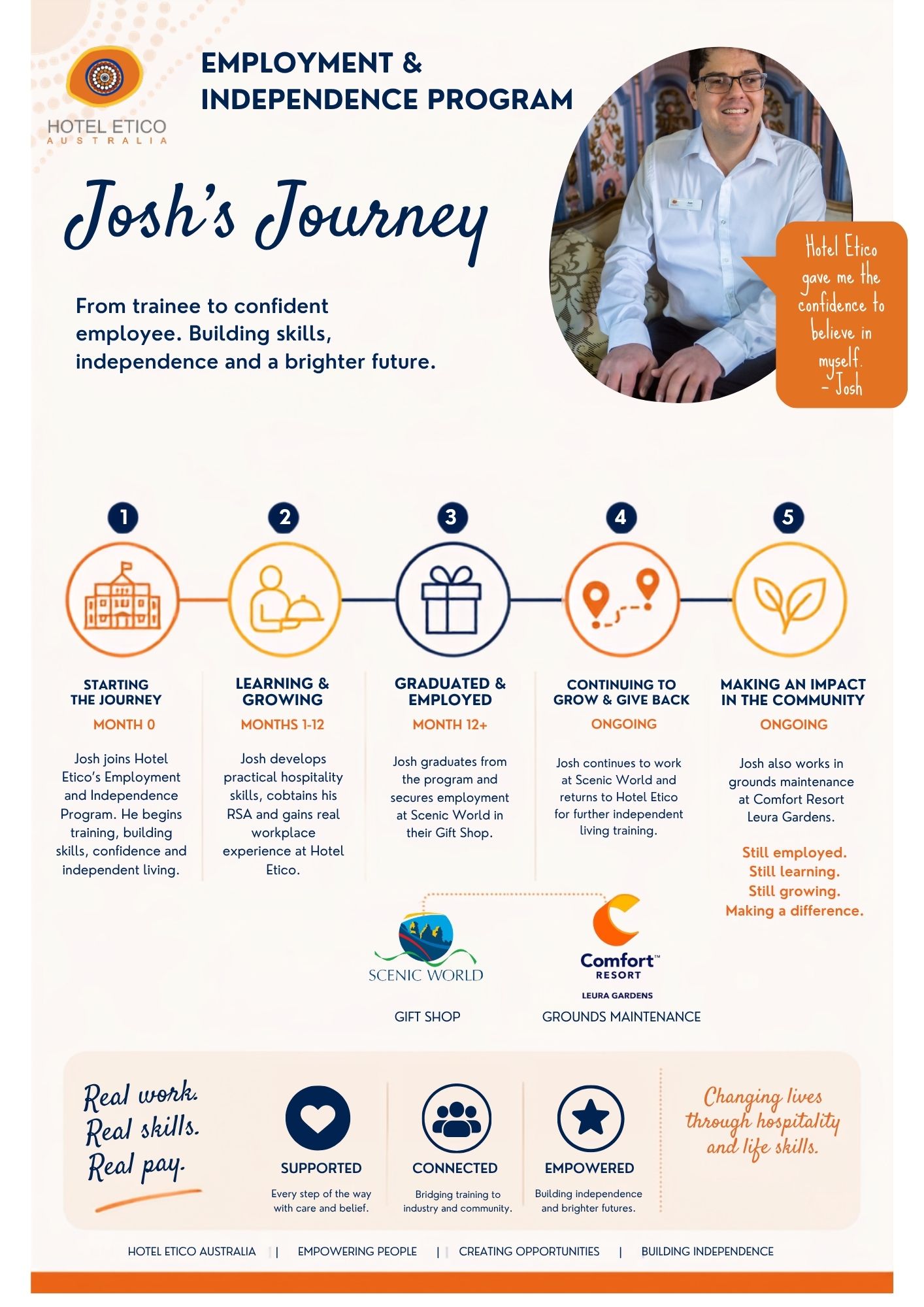 Our Industry Employment program commences after a trainee has completed their first year. Historically the program has has very high success rates with 98% of our trainees completing the program and approximately 75% of our graduates being able to secure industry employment. Trainees are often employed by one of our 27 employment partners.
Click here to see a full list of our employment partners.
We provide a clear pathway to open employment for trainees, including support in finding work, transitioning to work and support for employers. Our team uses a trainee’s goals for independence and work to plan the support to be provided during the second year. We help trainees prepare for job interviews, consult with employers to provide assistive technologies and advise on workplace modifications. We regularly check in with trainees during their second year, encouraging them to remain connected to Hotel Etico.
Graduates who are not working in the hospitality or tourism industry immediately after finishing training on site at one of our academies continue to receive support from Hotel Etico. Some trainees continue in the first stage of the program, honing their hospitality and independence skills.
Trainees who do not obtain jobs immediately post graduation and do not continue training at our academies continue to receive support to find work. Graduates who are not yet working in industry are invited back to work at Hotel Etico for specific events, to speak at our Information Sessions and at disability events and exhibitions.
FAQ
Do you have more questions? Browse through our comprehensive Frequently Asked Questions below or get in touch here to talk to our team.
What is the Hotel Etico Employment and Independence Program?
The Hotel Etico Employment and Independence Program is a hospitality, independent living and employment pathway for young adults aged 18 to 35 with disability and additional support needs. Delivered at a choice of two locations in Leura in the Blue Mountains, NSW and Canberra, ACT, the program helps young people build practical life skills, paid work skills and confidence in a supportive, real-world setting.
Young people join a highly successful pathway to paid open employment with our industry partner and eventually in industry, participating in the day-to-day operations of a hotel. Our program combines supported independent living on-site with hands-on paid work and employment support. This support continues after completing the residential part of the program, through our Industry Employment Program.
In the Industry Employment Program trainees are supported to move into industry-based work with career coaching and support for employers where necessary. With a rolling intake, families can begin the process throughout the year rather than waiting for a single annual start date.
Why is the Hotel Etico Employment and Independence Program Different?
What makes the Hotel Etico Employment and Independent Program different is that it is more than training. It combines independent living, real work with award wage payments, skills development and a clear pathway to open employment for young adults aged 18 to 35 with disability or additional support needs.
Who is this program for?
The Hotel Etico Employment and Independence Program supports young adults aged 18 to 35 with a disability and additional support needs who are ready to build confidence, independence and work skills in a supportive environment.
Many of the young people who have graduated from, or are currently participating in our training program, have an intellectual disability or are neurodiverse, have autism, ADHD or Down Syndrome, but we are open to applications from individuals with other support needs. Each candidate is treated as an individual and our application process is designed to determine how each candidate can be best supported within our program.
Our program operates at two campuses embedded in working hotels. One at the Comfort Resort Leura Gardens, NSW and the other at Mercure Canberra, ACT. The Hotel Etico Employment and Independence Program has a rolling intake so families do not need to wait for one specific time of year to begin the process.
What does the program cost and what payment options are available?
We help families understand the practical steps to begin our program, including pathways to NDIS funding or self funding. Where possible, our program is personalised to each trainee and we provide tailored advice and flexibility when needed to suit applicant’s needs and funding levels.
Our residential program costs approximately $85,000. Costs can vary depending on the support needs of each trainee.
Applicants participate in a sleepover and work trial before receiving a formal offer. We also conduct a thorough risk assessment during the application process. These steps allow us to determine supports additional to our standard offering and estimate costs.
We would love the opportunity to answer any questions about self-funding.
Please submit an Expression of Interest of Application and our team will be in touch.
How do I apply?
Our application progress is a simple online form to allow Hotel Etico to gain a better understanding of the applicants’ independence goals and support needs.
The online form requests the following information:
- NDIS Number (if applicants intend to use NDIS funding for the program).
- NDIS Plan’s Start and End Date
- Interests.
- Current skillset.
- Work goals.
- Independence and life goals.
- Ratio requirement for support workers.
- Personal care and support needs.
After this form is completed, trainees are encouraged to visit us at one of our two sites, participate in an interview, and may be invited to participate in a sleepover and work trial. We recommend applicants who intend to use NDIS funding apply or receive a funding review as soon as they are accepted into the program. We can provided tailored advice and are able to provide guidance for funding pathways.
Before taking this step, we encourage applicants to attend an information session at one of our two sites and speak to our staff and current trainees. Details of our upcoming information sessions can be found here.
How does the Hotel Etico Employment and Independence Program help someone to become more independent?
The program combines supported independent living, hands-on work experiece, training and employment support. Young people with a disability and other support needs have the opportunity to participate in the day-to-day operation of various departments of a working hotel and join a pathway that may lead to being employed, paid full award wages, all while being supported by industry professionals. Trainees stay in an en-suite room during their rostered days and practise everyday life skills in a shared living environment. Where possible, trainees have their own room during their rostered days, with private bathroom facilities, and shared spaces including a kitchen, dining room and lounge. Trainees may also share a bedroom and bathroom with another young person.
Independence is built through real routines including shopping, laundry, cleaning, downtime and shared meals, while also taking part in work shifts and specialist training. Trainees often organise social activitiees, such as movie nights or dinners at nearby restaurants.
Trainees follow a rotating weekly roster that currently includes either two days and one night or three days and two nights. This varies depending on locations and individual circumstances. During a work experience day, shifts are generally 4 hours each.
Our program continues into the second year (length may vary depending on funding and individual circumstances) through our Industry Employment Program, supporting our graduates in securing employment in the tourism and hospitality industry or other relevant employment.
To learn more about our program click here.
How will the Program to help build confidence and wellbeing?
Young people who join the Hotel Etico Employment and Independence Program build confidence, independence and social skills through real routines, real responsibility and real work experience, while building relationships with other trainees.
This is about participation and developing the skills needed for work and everyday life. Trainees gain confidence through hands-on hospitality experience in areas including food and beverage, housekeeping, reception/concierge and back of house/ kitchen.
Exposure to the different departments of a hotel and on the job training from our hospitality staff helps trainees build practical and transferable skills and improve their social and customer service skills. Alongside hospitality training, trainees practise independent living skills such as laundry, cleaning, shopping and everyday routines using structured, visual step-by-steps and support alongside them when needed. Training is delivered both formally and informally.
What support is available for trainees?
Support is available throughout the hotels and at the Academy of Independence. We employ disability support workers at the Academy who are available at a ratio of 1:1, 1:2 or 1:3 during waking hours, with one or more disability support workers sleeping over depending on need.
Trainees have more support in the first three months of the program and this may reduced as they become more independent and confident. Every member of staff undergoes an extensive induction program and is supported by a team of professionals. Staff are carefully selected based on hospitality and disability experience as well as alignment with our mission and values.
Our support workers help trainees with their responsibilities such as cleaning their rooms before leaving at the end of each rotation, participating in shared chores and planning social activities as a group. No tasks are completed for the trainees, but our support workers’ presence facilitates the trainees’ wellbeing and success. As part of our independent living program, trainees receive practical training and support from our support workers each week to ensure trainees meet their independence goals.
All staff are required to have a Working with Children Check and Criminal Record check, and receive NDIS-specific training.
What Safety Measures are in place for trainees?
Hotel Etico’s Academies are housed within real working hotels, Mercure Canberra , ACT and Comfort Resort Leura Gardens, NSW. Both of these businesses have safety policies for their staff and guests in case of emergencies and accidents. Trainees receive a site induction immediately when beginning their training with Hotel Etico. In the event of any emergency or incident, our support workers are responsible for the safety of trainees. Our support workers are specifically trained to respond in the event of an incident or emergency and ensure that all trainees on site are safe and accounted for.
As part of a trainee application and onboarding process, Hotel Etico carries out a thorough risk assessment. Any additional support needs which would impact trainees specifically during an emergency are identified and support workers are provided with a specific plan to ensure the trainee’s safety. This would include medical issues such as Epilepsy and other health conditions.
A senior member of Hotel Etico’s staff is on call seven days a week, and issues are first directed to the Academy Coordinators, and if they are not available our Chief Operating Officer. All staff are required to hold current Working with Children and Criminal Record Checks and undergo an extensive induction process. Staff are carefully selected based on their experience in hospitatliy and disability work as welll as their alignment with our values and mission. All staff receive an extensive induction before working in our program and are supported by a team of professionals.
How do the shifts work?
Trainees undergo work experience and shifts are generally 4 hours long. Shifts may occasionally be longer depending on needs and individual capabilities. Trainees attend the program for a maximum total of 44 hours a week. The rotating rosters are across two or three days, including one or two overnight stays depending on the week.
Where do Trainees stay?
Trainees stay in a dedicated on-site apartment during their rostered workdays (Academy of Independence).
Where possible, each trainee has their own room with a private bathroom and facilities. Shared spaces include a kitchen, dining room, and lounge. Trainees may also share a bedroom and bathroom with another young person. On non-rostered days, they independently return to their homes outside the program.
What happens during the day for trainees in the Program?
When trainees arrive at the Academy, they are likely to head straight to their rooms, finding sheets, towels and ensuring their uniforms are in order. Rosters change according to the day and how busy the hotel in which each Academy is housed is.
Between shifts trainees spend time together in their common room and during each rotation each trainee spends time with a support worker, to work on their independent living goals.
Trainees will spend some part of each day on shared chores including cooking, cleaning their rooms and shared areas, and laundry. Support workers help delegate tasks so that all trainees participate and pitch in.
Trainees manage their own time with support, which is a critical aspect of the training. Our program is a space where trainees are able to learn what works for them in a safe and controlled environment while still making their own decisions. Trainees do not have dedicated meal times together. Support workers encourage and facilitate trainees to participate in group social activities, but trainees are given the freedom to spend their downtime outside of training however they wish within the Academy.
Trainees are observed by staff and support workers so that if issues present, support workers intervene and contact carers and families to form a plan. These issues can include: avoiding participating in all social events, taking too long to get ready and struggling to be punctual to shifts and training.
We have provided an exemplar timetable below:
- 8 am – 9 am: Breakfast
- 10 am – 2 pm: Four-hour work experience shift in Food and Beverage department
- 2 pm – 4 pm: Unscheduled Down Time
- 4 pm – 6 pm: Independent Living Training
- 6:30 pm – 7:30 pm: Dinner
- 7:30 pm – 8:30 pm: Cleaning up after dinner with supervision.
- 8:30 pm onwards: Downtime and then sleep.
What do graduates and their families or carers say about the program?
“We are more than grateful that James had the opportunity to be trained at the Hotel Etico (Mount Victoria). It has significantly changed his life. The Hotel Etico Team is highly appreciated and respected. We will continue to support all of you. I wish you all success in your work with young people who have disabilities”
“We have experienced many providers, none were anywhere near as good as Hotel Etico. The others ‘talked the talk, but didn’t walk the walk”
“There’s not many like Etico that cover employment skills and independent living”
“What stood out with Hotel Etico was the Academy, where independence skills were actively practiced, paid training/work and hospitality skills with excellent support and the support to find work at the end of the program”
“I have not come across any other opportunities like Hotel Etico… nothing else leads to the mainstream employment opportunities provided by Hotel Etico”.
What are the employment opportunities after the training program?
Hotel Etico offers an established, trusted program with clear, proven pathways to employment. Hotel Etico has been running in Australia since 2020 but the first academy opened in Asti Italy in 2015. A total of 70 trainees have participated in the program so far, with a 98% graduation rate. Of those graduates 70-80% have transitioned to industry employment.
Hotel Etico currently works with 27 employment partners. Some trainees have received offers of work through or outside the program during their first year. Graduates receive individualised support from our industry employment team and support and training is provided to employers where necessary.
Trainees who have not yet secured industry employment, as well as our graduates are often offered the opportunity to work at one-off events at our campuses or at external events and to speak at disability or employment-focussed events. Previous trainees and graduates for example have worked at the Brisbane Convention Centre for the World Down Syndrome Congress, serving up to five hundred delegates at the Congress Dinner.
How do Trainees travel to the Program on their workdays?
Trainees are expected to commute to the Academy independently either by public transport or by car.
In Leura support is not provided for trainees to catch public transport but support workers are able to pick trainees up from the train station.
If commuting independently is an important goal for a specific trainee, we are able to provide support during their independent living sessions. Additional support to this, including support workers commuting with trainees, would likely be an additional cost on top of normal program fees.
How can I best prepare someone for the experience when they are accepted into the Program?
We recommend potential trainees practise skills that are likely to be covered by the Hotel Etico Employment and Independence Program. The best way to help someone for our program is to ask questions, for example asking what part of hospitality and tourism work is most interesting for them. If an applicant is interested in a specific area such as housekeeping or barista work, they can practise relevant skills at home.
Suggestions include:
- Taking on household chores including supervised cooking, shopping for a recipe, etc.
- Preparing skills required to independently arrive at work including ironing clothes and catching public transport.
- Practice commuting to the hotel before beginning the program.
- Attend hospitality venues to watch what hospitality and tourism workers are required to do.
It is important to make sure trainees understand what to expect from our program. Help them to imagine their life within the program including the training they are going to receive and what living at our accommodation will involve. Check if the trainee has any questions or concerns, if they are do, we are here to help, just get in touch.
How long does the program last?
Trainees rotate through a range of hospitality work experience roles during Year One, living on-site with other trainees during their rostered days. Some trainees can transition to industry employment during their first year, not requiring a full year of training to meet their hospitality and independence goals. Other trainees do not transition directly into employment, opting to train with us for longer until they are ready for work. This additional training on-site is subject to funding, through the NDIS or self-funded.
Other trainees who do not immediately begin work after finishing a year of training are able stay engaged with the program and Hotel Etico by joining our alumni community. We offer our graduates one off work opportunities at events, invite them to speak at disability expos and invite them to speak to prospective parents at our on-site information sessions.
What happens if there is a problem during the program?
How long has the Hotel Etico Employment and Independence Program been operating?
The Hotel Etico Employment and Independence Program has operated in Australia since 2020. The Etico model was first established at a Hotel in Asti Italy in 2015.
To learn more about the impact of our program, please click through here.
How do I know if my child will be safe and supported?
Trainees living at Hotel Etico have access to support from support workers at a ratio of 1:1, 1:2 or 1;3 depending on the individual’s needs. All staff are NDIS trained and have Working With Children and Criminal Record Checks. Staff receive a specific program induction and are supported by a team of professionals.
As part of the trainee’s application and onboarding process, a thorough risk assessment is conducted by our staff using information provided by carers and families. In the event of any emergency, support workers are aware of all trainees’ needs and any medical conditions and are trained to respond and keep traineees safe.
Any specific safety concerns can be answered by our staff over the phone. To see our contact details, click here.
How can I know if a young person is ready for the Program?
The first step to understanding our program is to attend an information session at one of our Academies. These sessions will give you the opportunity to speak to current trainees and staff, to better understand how the program works and whether it could be suitable for your young person.
Our application process is designed to assist us in gaining an understanding of the applicant and for the applicant to decide if they are interested in the Program. The interview and visit to our sites, as well as the sleepover can help trainees, their families/carers and our staff determine any potential issues for the trainee before they begin our program. We advise carers, parents or families to discuss what the program involves day to day, as well as the expectations of trainees in terms of their willingness to try new work and tasks outside of their comfort zones.
If an applicant needs to develop a specific skill before commencing the program, this is identified by our staff and communicated with the applicant and their family or carers. Examples include practicing personal care and hygiene as Hotel Etico does not provide personal care support, or increasing interpersonal communication skills.
The trial sleepover and work trial trainees participate in before receiving an offer for the program is used to identify risks and additional support needs.
For further details about the Program, click through here.
We encourage all parents and carers who are interested in the Program for a family member, to reach out to our staff. To contact us click through to here.
Who can I contact if I have questions?
To speak to our staff, use the contact details provided at the following link.
We recommend that you attend an information session in person at one of our sites, if possible, as this will give you the opportunity to see meet our staff, and speak to current trainees to gain a better understanding of the program.
What happens if our funding changes?
Our staff will ensure you have sufficient funding from the NDIS or receive assurance about your self-funding before each trainee begins the program. If there is insufficient funding within your NDIS plan, you will immediately be notified and advised to apply for a review of your NDIS plan.
We advise you begin this process, including obtaining any necessary evidence from medical specialists, occupational therapists, psychologists and psychiatrists as soon as possible. NDIS plan reviews can take six months or longer.
If you are unable to obtain funding in time, we will consult with you about how to keep the trainee engaged with the program for as long as possible. This could involve reduced hours in each weekly rotation or taking a break from training.
We invoice our program weekly so there is also an option of self-funding, which we would discuss well in advance of your funding running out.
What do trainees do on their day off?
Trainees who are not currently staying on site return to their homes outside of the program. Trainees only work eight hours during their rotation and receive one-one one support each week to work on their independent living goals. Trainees also have downtime and are encouraged to participate in group activities by our staff and support workers.